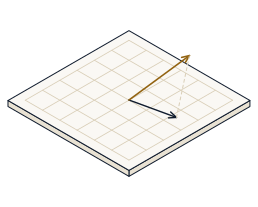
Build vector pairs and read their determinant, angle and projection in the sandbox, and predict — before you read it off the screen — whether a pair is linearly independent, the dimension of its span, the angle between two vectors, and the projection of one vector onto another.
The determinant det(u, v) = u1 v2 - u2 v1 of a pair of plane vectors is one number that decides everything: det ≠ 0 means the pair is linearly independent and its span is the whole plane — span dimension 2; det = 0 means the vectors are dependent and the span collapses to a line — dimension 1. The angle comes from the dot product, and the projection of u onto v divides by v·v = ‖v‖², not ‖v‖.
Open the sandbox. Each step names the two vectors u and v to set from their components; type them into the inputs or drag the arrow handles, and read the determinant, span, angle and projection readouts.
u = (u1, u2),  v = (v1, v2)   (set the two vectors each step names)
Read:  det(u,v),  span dimension,  angle,  projection coefficient
Watch the determinant, span-dimension, angle and projection readouts in the main panel — every number you predict is printed there.
Set u = (3, 1) and v = (1, 2). The determinant is det(u, v) = u1 v2 - u2 v1. Predict det(u, v) and whether the pair is independent, then read the readouts.
The readout shows det(u, v) = 3·2 - 1·1 = 5. Because det ≠ 0, the pair is linearly independent and its span is the whole plane — span dimension 2.
Set u = (1, 2) and v = (2, 4) — so v = 2u. Predict the dimension of the span, then read the span readout.
The determinant is det(u, v) = 1·4 - 2·2 = 0, so the pair is dependent and the span dimension is 1: both vectors lie on one line through the origin, not the whole plane.
Set u = (1, 1) and v = (1, 0). The angle comes from the dot product, cosθ = (u·v) / (‖u‖ ‖v‖). Predict θ, then read the angle readout.
The readout shows θ = 45°: the vector (1, 1) points exactly halfway between the axes, so it makes a 45° angle with the x-axis direction (1, 0).
Set u = (4, 5) and v = (2, 0). The projection of u onto v is proj = ((u·v) / (v·v)) v. Predict the coefficient, then read it.
The coefficient is (u·v) / (v·v) = 8 / 4 = 2, so proj = (4, 0). The divisor is v·v = ‖v‖² = 4, not ‖v‖ = 2 — dividing by ‖v‖ once too few is the classic slip.
Everything above is waiting in the sandbox. Drag the arrow handles to build any two vectors, watch the parallelogram, the span line and the projection update in real time, and see the determinant, angle and independence verdict change at once.
- Read a pair's determinant, det(u, v) = 5, and saw det ≠ 0 means linearly independent — span dimension 2
- Saw a dependent pair (det = 0) collapse to span dimension 1 — a line, not the plane
- Measured the angle between (1, 1) and (1, 0) as 45°
- Projected (4, 5) onto (2, 0) to coefficient 2, dividing by ‖v‖² not ‖v‖
- Every value you predicted is the demo's own vector arithmetic, not a picture